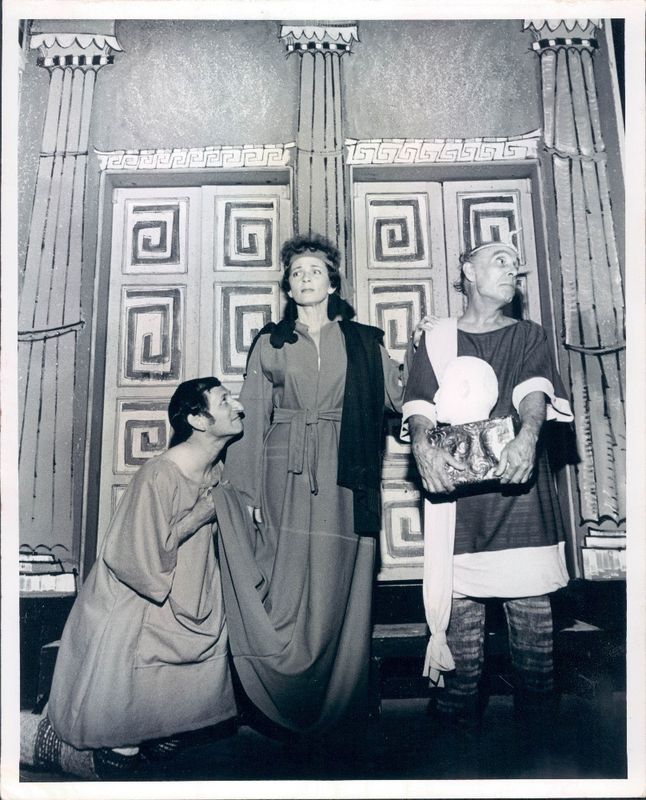
Dee Garrett (center) and Coley Worth (right)
In 1977, I began my college career at Indian River State College in Fort Pierce, Florida. As always, I chose that particular school because of one professor who taught there and I wanted to learn from him. I was delighted to find not just one professor of interest in that small community college but three others.
One of those professors was a woman named Ada Coats Williams who was an English instructor. I will write about her in detail someday soon but this is not the day. However, I took a Creative Writing class under Ms. Williams and it opened a door that has never closed.
It wasn't just the instruction I received from Ms. Williams but the meeting and friendship of the students who attended that class that changed me; a boy only 18 years of age. Because attending that class were people of experience, wisdom and depth.
There was a former speech-writer for Governor Nelson Rockefeller. There was a hospice nurse, a Viet Nam vet, a member of the US Diplomatic Corps, a hilarious older Jewish mother who was infinitely proud of her two children, and there were others.
But then there was Coley Worth and his adorable wife, Marcia. This was one of the funniest men I have ever met and Marcia was always the perfect and willing foil to his humor, sometimes having the better lines of the two.
He was born as Coleman Rothmund. His father had operated a minstrel show where Coley, his sister and brother learned to perform before fleeing to join the vaudeville circuit.
Coley had begun his entertainment career as a vaudeville comedian in the late 1920's and make his Broadway debut in A la Carte in 1927. It is still possible to see his act listed in old Billboard magazines from the time period. Listings of him and the occassional review appeared of his performances from New York to New Orleans to Chicago and all points between.
His wit was political, it was sometimes caustic, but Coley had a way of making his real humor hidden beneath the joke. One reviewer for Billboard wrote: "Coley Worth hid his comedy value under old material. When he got off his ad libs - he showed plenty of zany potential, but the hoary routines weren't up to his smart delivery." In other words, Coley's improvisations were the mainstay of his routines. The jokes were just the platform and any old, shop-worn joke would do. The ad-libs suited him well and would continue to suit him for the rest of his career.
Beverly Sills, the great soprano of the Metropolitan Opera in New York City, mentioned Coley in her autobiogarphy Bubbles. She wrote of Coley's ad-libs from the 1960's-70's that would catch her off-guard and make her pause until she could compose herself. She once referred to Coley as "the funniest man I ever knew."
While in New York City in the late 30's, Coley took in a performance of the Radio City Music Hall "Rockettes." These were the high-kicking dancers that spawned so many similar acts. They performed en ensemble with 20-30 dancers or more.
Out of that collection of 20-30, Coley spotted one particular raven-haired beauty and he was determined to meet her. They met, they fell in love and they got married. Marcia Ray was her name and she became Marcia Worth. She eventually joined Coley's vaudeville act and they became known as "Coley Worth and Marcia." All the reviews of the time agree that adding "the statuesque Marcia" was the best thing he could ever do for his act.
According to Coley, adding Marcia to his life was the best thing he ever did. Even in his seventies, Coley would look at Marcia and he still saw the Rockette.
One of those professors was a woman named Ada Coats Williams who was an English instructor. I will write about her in detail someday soon but this is not the day. However, I took a Creative Writing class under Ms. Williams and it opened a door that has never closed.
It wasn't just the instruction I received from Ms. Williams but the meeting and friendship of the students who attended that class that changed me; a boy only 18 years of age. Because attending that class were people of experience, wisdom and depth.
There was a former speech-writer for Governor Nelson Rockefeller. There was a hospice nurse, a Viet Nam vet, a member of the US Diplomatic Corps, a hilarious older Jewish mother who was infinitely proud of her two children, and there were others.
But then there was Coley Worth and his adorable wife, Marcia. This was one of the funniest men I have ever met and Marcia was always the perfect and willing foil to his humor, sometimes having the better lines of the two.
He was born as Coleman Rothmund. His father had operated a minstrel show where Coley, his sister and brother learned to perform before fleeing to join the vaudeville circuit.
Coley had begun his entertainment career as a vaudeville comedian in the late 1920's and make his Broadway debut in A la Carte in 1927. It is still possible to see his act listed in old Billboard magazines from the time period. Listings of him and the occassional review appeared of his performances from New York to New Orleans to Chicago and all points between.
His wit was political, it was sometimes caustic, but Coley had a way of making his real humor hidden beneath the joke. One reviewer for Billboard wrote: "Coley Worth hid his comedy value under old material. When he got off his ad libs - he showed plenty of zany potential, but the hoary routines weren't up to his smart delivery." In other words, Coley's improvisations were the mainstay of his routines. The jokes were just the platform and any old, shop-worn joke would do. The ad-libs suited him well and would continue to suit him for the rest of his career.
Beverly Sills, the great soprano of the Metropolitan Opera in New York City, mentioned Coley in her autobiogarphy Bubbles. She wrote of Coley's ad-libs from the 1960's-70's that would catch her off-guard and make her pause until she could compose herself. She once referred to Coley as "the funniest man I ever knew."
While in New York City in the late 30's, Coley took in a performance of the Radio City Music Hall "Rockettes." These were the high-kicking dancers that spawned so many similar acts. They performed en ensemble with 20-30 dancers or more.
Out of that collection of 20-30, Coley spotted one particular raven-haired beauty and he was determined to meet her. They met, they fell in love and they got married. Marcia Ray was her name and she became Marcia Worth. She eventually joined Coley's vaudeville act and they became known as "Coley Worth and Marcia." All the reviews of the time agree that adding "the statuesque Marcia" was the best thing he could ever do for his act.
According to Coley, adding Marcia to his life was the best thing he ever did. Even in his seventies, Coley would look at Marcia and he still saw the Rockette.
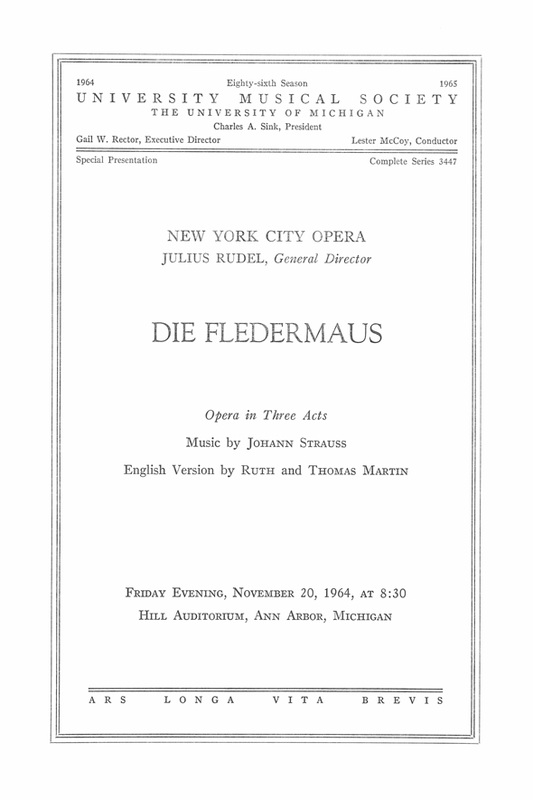
Die Fledermaus program from a road performance in 1964.
In the 1960's, Coley performed on Broadway in A Funny Thing Happened on the Way to the Forum as well as in the travelling stage show of Hello, Dolly! with Ginger Rogers in the lead role. Later he was in the same production but with Betty Grable in the lead. He was also in Man of La Mancha during the same period.
In 1967, he appeared on television as Professor Gustav Steinhart on The Jackie Gleason Show in the "Hair to a Fortune" episode. It is on DVD.
In the early 1970's he returned to Broadway in 70, Girls, 70 but had drawn the attention of the Metropolitan Opera of New York a years earlier. The Met had cast him as the Major-General in H.M.S. Pinafore and as Joseph Porter in Pirates of Penzance. 1977 saw a revival of Anything Goes with Coley performing.
But without a doubt, his most famous role was as Frosch, the drunken jailor, in Johann Strauss' Die Fledermaus (The Bat). This was a role he played 15 times or more. One reviewer in the Toldeo Blade, said that Coley "carried off the role hilariously." In fact, Coley has become the standard by which all other actors approach the role of Frosch. Lee Cass was the actor who took the role after Coley suffered a stroke in 1978. In an interview, Cass admitted that "Most of what I do is taken directly from Coley Worth."
In 1967, he appeared on television as Professor Gustav Steinhart on The Jackie Gleason Show in the "Hair to a Fortune" episode. It is on DVD.
In the early 1970's he returned to Broadway in 70, Girls, 70 but had drawn the attention of the Metropolitan Opera of New York a years earlier. The Met had cast him as the Major-General in H.M.S. Pinafore and as Joseph Porter in Pirates of Penzance. 1977 saw a revival of Anything Goes with Coley performing.
But without a doubt, his most famous role was as Frosch, the drunken jailor, in Johann Strauss' Die Fledermaus (The Bat). This was a role he played 15 times or more. One reviewer in the Toldeo Blade, said that Coley "carried off the role hilariously." In fact, Coley has become the standard by which all other actors approach the role of Frosch. Lee Cass was the actor who took the role after Coley suffered a stroke in 1978. In an interview, Cass admitted that "Most of what I do is taken directly from Coley Worth."
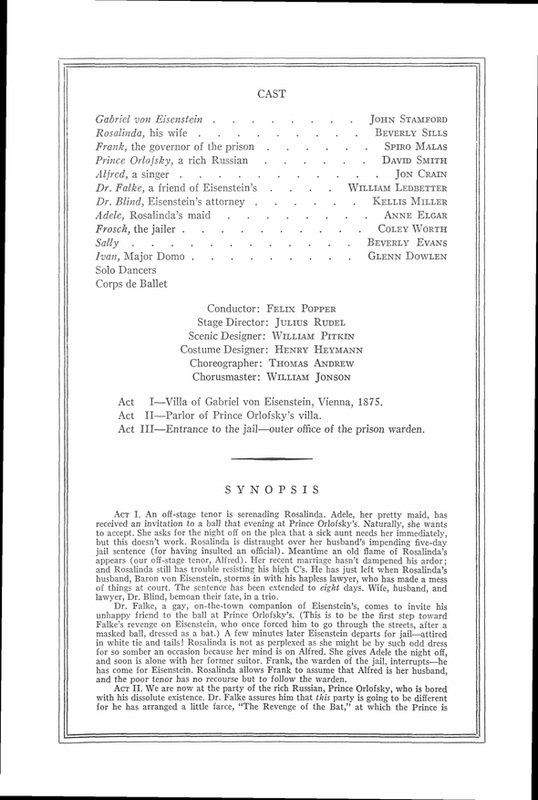
The Cast page from the above program.
In one performance of Die Fledermaus, Beverly Sills recalled the scene where she wore a low-cut evening gown and was smoking a cigarette with a cigarette-holder. Coley walked up to her and said "Smoking, I see." Then, looking down her dress, added "And filter-tipped, too!" She had said that it was difficualt to recover from that.
It was just after his performance in Anything Goes that I met Coley Worth and Marcia. As I said, we all took Ms. Williams' class together.
Marcia still thought he was funny and she always smiled brightly and laughed at his jokes. Even the old ones.
That is in no way to suggest, however, that Marcia was a witless trophy wife of a by-gone day. She was funny. She had a very quick wit. But she was great at giving him the set-up lines.
I'll have to admit that Coley upset me once. When we had written our assignments, Ms. Williams would have us read them to the rest of the class. On one assignment, I had written what I thought to be a moving piece that was sure to bring forth tears from my hearers! As I was reading it, however, Coley was absolutely howling with laughter. And I mean howling! I can still hear it in my head. The difference is that now it makes me smile to hear it.
At the time, I was annoyed beyond belief. Ms. Williams was emabarrassed for me. Marcia scolded him. I fumed. In fact, I asked him what was so funny. He answered, "Sorry, kid. I know you want it to be serious but here's why it's funny..." and he then showed me that the way I wrote it left these hilarious underpinnings that he loved from the beginning of his career. He showed me what funny really was. He changed the way I wrote in profound ways. Ms. Williams showed me how to use the tools but Coley Worth showed me how to craft.
We loved that class so much that we begged for a Creative Writing 102 where none had existed at that college. We did not want to separate from each other. Ms. Williams went to the curriculum committee and they granted her petition for a second semester of Creative Writing. So, in 1978, most of us enrolled in the new class.
In between the classes, however, Coley suffered a stroke that left him in a wheelchair and with slurred speech. I know I shouldn't say it like this but... it only made him funnier! And he knew it. He said the most God-awful things and then, when he was reprimanded by Marcia or Ms. Williams, would blame it on "that damned stroke."
He told stories of all the old actors and the old playhouses. We went to see Ginger Rogers performing at the Burt Reynolds' Dinner Theater in Jupiter, Florida. This was the place for actors whose careers were in twilight. It was fun to see them perform, but a bit sad, too.
After the show, Coley and Marcia took me backstage to see Ms. Rogers who had been in so many performances with Coley so many years before. When she saw Coley, she brightly asked, "Well, Coley? Any advice?" "Yeah," replied the chair-bound Coley, "Get out of show business. You look ridiculous." She was stunned. Marcia was horrified. I wanted to hide.
Coley pressed on with "Don't be remembered as a dottering old has-been!" And we knew that he was talking about himself.
I went on to another college in 1979 and never got to see him again. He left us in 1987.
The New York Times carried the news of his passing. It was the October 14, 1987 issue; my birthday.
New York Times: Coley Worth, 79, Dies; Actor and a Comedian
Published: October 14, 1987
Coley Worth, an actor, singer, comedian and dancer in theater and television, died of pneumonia last Friday in Port St. Lucie, Fla. He was 79 years old and lived in Port St. Lucie.
Mr. Worth performed often with the New York City Opera, specializing in the role of Frosch in ''Die Fledermaus,'' which he performed with many other opera companies around the country, as well as the Major General in ''H.M.S. Pinafore'' and Joseph Porter in ''Pirates of Penzance.''
Mr. Worth, born in Rome, N.Y., was originally named Coleman Rothmund. His father, a tailor, also operated a minstrel show where Mr. Worth, his sister and his brother learned to perform before running away to join the vaudeville circuit.
Mr. Worth made his Broadway debut in 1927 in ''A la Carte.'' His Broadway credits later included ''A Funny Thing Happened on the Way to the Forum'' and ''Seventy Girls Seventy,'' as well as national tours of ''Hello, Dolly!'' and ''Man of La Mancha.''
Mr. Worth and his wife, Marcia Ray, toured for many years as a vaudeville act called ''Coley Worth and Marcia.''
In addition to his wife, he is survived by three daughters, Caroline Worth-Tyrrell of Morristown, N.J., Wendy Worth of New York City and Penny Worth Anderson of Chicago; a son, Peter, of Stuart, Fla.; and four grandchildren.
If only I could have seen him one more time.
It was just after his performance in Anything Goes that I met Coley Worth and Marcia. As I said, we all took Ms. Williams' class together.
Marcia still thought he was funny and she always smiled brightly and laughed at his jokes. Even the old ones.
That is in no way to suggest, however, that Marcia was a witless trophy wife of a by-gone day. She was funny. She had a very quick wit. But she was great at giving him the set-up lines.
I'll have to admit that Coley upset me once. When we had written our assignments, Ms. Williams would have us read them to the rest of the class. On one assignment, I had written what I thought to be a moving piece that was sure to bring forth tears from my hearers! As I was reading it, however, Coley was absolutely howling with laughter. And I mean howling! I can still hear it in my head. The difference is that now it makes me smile to hear it.
At the time, I was annoyed beyond belief. Ms. Williams was emabarrassed for me. Marcia scolded him. I fumed. In fact, I asked him what was so funny. He answered, "Sorry, kid. I know you want it to be serious but here's why it's funny..." and he then showed me that the way I wrote it left these hilarious underpinnings that he loved from the beginning of his career. He showed me what funny really was. He changed the way I wrote in profound ways. Ms. Williams showed me how to use the tools but Coley Worth showed me how to craft.
We loved that class so much that we begged for a Creative Writing 102 where none had existed at that college. We did not want to separate from each other. Ms. Williams went to the curriculum committee and they granted her petition for a second semester of Creative Writing. So, in 1978, most of us enrolled in the new class.
In between the classes, however, Coley suffered a stroke that left him in a wheelchair and with slurred speech. I know I shouldn't say it like this but... it only made him funnier! And he knew it. He said the most God-awful things and then, when he was reprimanded by Marcia or Ms. Williams, would blame it on "that damned stroke."
He told stories of all the old actors and the old playhouses. We went to see Ginger Rogers performing at the Burt Reynolds' Dinner Theater in Jupiter, Florida. This was the place for actors whose careers were in twilight. It was fun to see them perform, but a bit sad, too.
After the show, Coley and Marcia took me backstage to see Ms. Rogers who had been in so many performances with Coley so many years before. When she saw Coley, she brightly asked, "Well, Coley? Any advice?" "Yeah," replied the chair-bound Coley, "Get out of show business. You look ridiculous." She was stunned. Marcia was horrified. I wanted to hide.
Coley pressed on with "Don't be remembered as a dottering old has-been!" And we knew that he was talking about himself.
I went on to another college in 1979 and never got to see him again. He left us in 1987.
The New York Times carried the news of his passing. It was the October 14, 1987 issue; my birthday.
New York Times: Coley Worth, 79, Dies; Actor and a Comedian
Published: October 14, 1987
Coley Worth, an actor, singer, comedian and dancer in theater and television, died of pneumonia last Friday in Port St. Lucie, Fla. He was 79 years old and lived in Port St. Lucie.
Mr. Worth performed often with the New York City Opera, specializing in the role of Frosch in ''Die Fledermaus,'' which he performed with many other opera companies around the country, as well as the Major General in ''H.M.S. Pinafore'' and Joseph Porter in ''Pirates of Penzance.''
Mr. Worth, born in Rome, N.Y., was originally named Coleman Rothmund. His father, a tailor, also operated a minstrel show where Mr. Worth, his sister and his brother learned to perform before running away to join the vaudeville circuit.
Mr. Worth made his Broadway debut in 1927 in ''A la Carte.'' His Broadway credits later included ''A Funny Thing Happened on the Way to the Forum'' and ''Seventy Girls Seventy,'' as well as national tours of ''Hello, Dolly!'' and ''Man of La Mancha.''
Mr. Worth and his wife, Marcia Ray, toured for many years as a vaudeville act called ''Coley Worth and Marcia.''
In addition to his wife, he is survived by three daughters, Caroline Worth-Tyrrell of Morristown, N.J., Wendy Worth of New York City and Penny Worth Anderson of Chicago; a son, Peter, of Stuart, Fla.; and four grandchildren.
If only I could have seen him one more time.
 RSS Feed
